



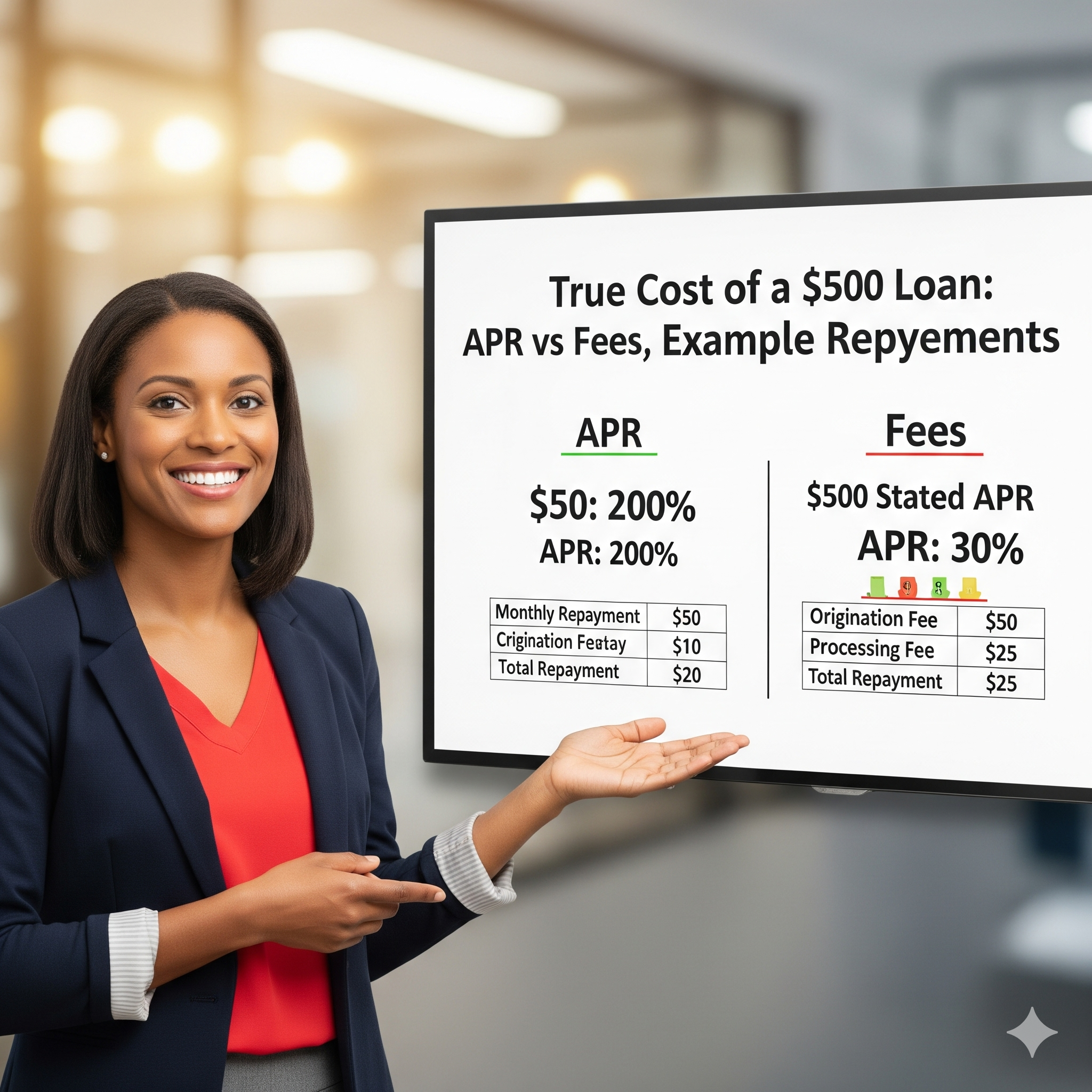
True Cost of a $500 Loan: APR vs Fees, Example Repayments in 2026
When a financial emergency hits, many borrowers turn to short-term loans for fast relief. A $500 loan may seem manageable, but the true cost can vary sharply depending on whether the lender charges interest through an APR, uses flat fees, or combines fees with a short repayment window. That difference matters more than many borrowers realize.
EasyFinance.com, a BBB-accredited business, helps borrowers compare online lenders offering transparent loan options up to $2,000. The goal is to help borrowers look beyond fast approval and understand the total repayment amount before accepting any offer.
If you are comparing a $500 cash advance no credit check, it is important to review more than the approval speed. You should compare the APR, fees, repayment date, payment schedule, and whether the loan fits your next paycheck or income deposit.
What Is the True Cost of a $500 Loan?
The true cost of a $500 loan is the total amount you must repay, including the borrowed amount, interest, finance charges, flat fees, origination fees, late fees, returned-payment fees, extension costs, or rollover charges. A loan can look affordable at first because the fee is shown as a flat dollar amount, but the cost may be much higher when the repayment period is short.
For example, a $75 fee on a $500 loan may seem simple. But if that $575 repayment is due in 14 days, the annualized cost can be extremely high. That is why borrowers should compare both the dollar cost and the APR whenever possible.
| Cost Factor | What It Means | Why It Matters |
|---|---|---|
| Loan amount | The amount you borrow | A smaller amount is usually easier to repay |
| APR | The annualized cost of borrowing | Helps compare different loan products more clearly |
| Flat fee | A fixed dollar charge for borrowing | May look simple but can become expensive on short terms |
| Repayment term | How long you have to repay | Shorter terms can make APR much higher |
| Total repayment | The full amount you pay back | Shows the real dollar cost of the loan |
APR vs. Fees: What Is the Difference?
APR, or Annual Percentage Rate, reflects the yearly cost of borrowing, including interest and certain finance charges. It gives borrowers a standard way to compare different loan products. Flat fees, by contrast, charge a fixed amount based on the amount borrowed, often without making the yearly cost obvious at first glance.
For example, an installment loan with a 36% APR may sound expensive, but a fee-based payday-style loan can cost far more when converted into APR terms. That is why borrowers comparing $500 payday loans online same day should always check both the total dollar repayment and the effective APR.
How a Flat Fee Can Become a Very High APR
Many payday-style lenders charge a fee such as $15 to $20 for every $100 borrowed. On a $500 loan, that can mean a fee of $75 to $100. If that loan is due in two weeks, the annualized cost can become very high because the borrower is paying the fee over a very short period.
Example:
- $500 borrowed
- $75 fee
- $575 total repayment in 14 days
That may not sound extreme at first, but because the repayment happens quickly, the effective APR can be about 391%. This is one reason borrowers often underestimate the cost of short-term fee-based loans.
Example Repayment Scenarios for a $500 Loan
The cost of a $500 loan can change dramatically depending on the repayment structure. The examples below are simplified and are for comparison only. Actual lender terms vary by state, borrower eligibility, and loan product.
| Loan Example | Amount Borrowed | Fee or Interest Structure | Repayment Timing | Estimated Total Repayment |
|---|---|---|---|---|
| Fee-based short-term loan | $500 | $75 fee | 14 days | $575 |
| Higher-fee short-term loan | $500 | $100 fee | 14 days | $600 |
| Installment loan at lower APR | $500 | APR-based interest | Several months | Varies by APR and term |
| Longer-term higher-APR installment loan | $500 | Higher APR, smaller payments | Multiple installments | May be predictable but can cost more over time |
Borrowers searching i need $500 dollars now no credit check often focus on speed, but the repayment structure can matter just as much as approval. A loan that funds quickly can still become difficult if the full repayment is due before your next budget cycle can support it.
APR Example: Why a $75 Fee Can Equal About 391%
APR annualizes the cost of borrowing. For a short-term loan, this can make a flat fee look much larger because the same fee is being measured as if it repeated over a full year.
A simplified APR formula for a payday-style loan is:
APR = (Fee ÷ Loan Amount) × (365 ÷ Loan Term in Days) × 100
Using a $500 loan with a $75 fee due in 14 days:
- $75 ÷ $500 = 0.15
- 365 ÷ 14 = 26.07
- 0.15 × 26.07 × 100 = about 391%
This does not mean you pay 391% in 14 days. It means the cost is equivalent to about 391% when annualized. That is why both the APR and the actual dollar repayment amount matter.
Why APR Is Usually Better for Comparing Loans
APR is not perfect, but it gives borrowers a clearer way to compare loan products side by side. A flat fee may look simpler, but it can hide how expensive the loan really is when the repayment window is short.
When you compare APR, total repayment, and due dates together, it becomes easier to see which loan is actually more affordable. This is especially important when deciding between a payday-style product and an installment-style product. One may look cheaper at first glance, while the other may be easier to repay and cost less overall.
When Fee-Based Loans Become Risky
The biggest risk is not always the first fee. The real problem begins when a borrower cannot repay on time and has to refinance, extend, roll over, or replace the loan with another short-term loan. A small fee-based loan can become very expensive when the cycle repeats.
Before accepting a fee-based loan, review:
- The full amount due on the repayment date
- Whether repayment is one payment or multiple installments
- What happens if the payment is late
- Whether extensions, renewals, or refinancing are allowed
- How much an extension or rollover would cost
- Whether the lender charges returned-payment fees
- Whether repayment will be automatically withdrawn from your account
Payday Loan vs. Installment Loan: Which May Cost Less?
A payday-style loan may be faster and simpler, but the full repayment may be due in one payment. An installment loan may spread payments over time, which can make budgeting easier. However, a longer repayment term can also increase total interest if the APR is high.
| Comparison Point | Payday-Style Loan | Installment Loan |
|---|---|---|
| Repayment structure | Often one lump-sum payment | Multiple scheduled payments |
| Speed | Often designed for fast emergency funding | May also be fast, depending on lender |
| Cost display | Often shown as a flat fee | Often shown as APR and payment schedule |
| Budget pressure | Can be high if due all at once | May be easier to manage with smaller payments |
| Main risk | Rollover, extension, or repeat borrowing | Higher total cost if term is long and APR is high |
The better option depends on your income timing, repayment ability, and total cost. The strongest loan is not always the fastest one. It is the one you can repay without creating a larger financial problem.
State-Specific Loan Rules Matter
Some states cap payday loan amounts, restrict fees, limit repayment terms, or require specific lender disclosures. In California, for example, borrowers often compare $255 payday loans online same day because of the state’s payday-loan cap structure. In those states, a borrower may not be able to access a full $500 payday loan, which changes both the loan choice and repayment strategy.
EasyFinance.com helps borrowers compare lenders operating under applicable state rules so they can review options that are more transparent and appropriate for where they live.
When a Larger Installment Loan May Cost Less Overall
Some borrowers assume a bigger loan is always more expensive, but that is not always true. In some cases, a structured installment product such as a 1000 dollar loan may be easier to manage than taking multiple fee-based payday loans back to back.
If repayment is spread across months instead of one paycheck, the payment pressure may be lower and the total cost may be more predictable. That does not mean a larger loan is always the right move. It means the structure matters. Borrowers should compare total repayment, not just the amount borrowed.
No-Credit-Check Loan Alternatives
Borrowers with poor credit or thin credit files often compare loans with no credit when traditional lenders decline them. These products may rely more on income, recurring deposits, and bank activity than on credit score. They can expand access, but they should still be reviewed carefully for total cost, repayment timing, lender transparency, and state availability.
“No credit check” does not mean “no review.” A lender may still verify identity, income, bank account activity, repayment ability, and eligibility before approving a loan.
Emergency Uses for $500 Loans
Many borrowers use small-dollar loans for urgent needs such as rent, utilities, car repairs, groceries, childcare, or healthcare bills. If you are searching i need money now, speed may be important, but it should not be the only factor.
The right emergency loan is one that solves the problem today without making next month’s finances harder to manage. If the repayment will cause you to miss rent, utilities, food, transportation, or other essentials, the loan may not be affordable even if you can get approved.
Alternative Lenders and Tribal Loans
Some borrowers also compare easiest tribal loans to get or tribal loans online. These products may offer more flexible approval paths, but APRs and fees can be high. Borrowers should read the terms carefully, compare total repayment, and avoid focusing only on speed or ease of approval.

How to Compare the True Cost of a $500 Loan
Before accepting any $500 loan, compare these points:
- The exact amount you receive
- The exact amount you must repay
- The APR or finance charge
- The flat fee, if one applies
- The due date or installment schedule
- Whether repayment is automatic
- Any origination fees, late fees, returned-payment fees, rollover fees, or extension costs
- Whether early repayment is allowed
- Whether the lender is licensed or legally allowed to offer loans in your state
The best loan is not always the fastest one. It is the one with a repayment structure you can realistically handle.
Affordability Checklist Before Accepting a $500 Loan
Before accepting a loan, compare the repayment amount with your next paycheck, benefit deposit, or expected income. Then subtract essential expenses. If the loan payment does not fit after essentials, the loan may create another emergency.
| Question | Why It Matters |
|---|---|
| Can I repay on time without missing rent or utilities? | Missing essential bills can create larger costs later. |
| Is repayment due in one payment? | A lump-sum repayment can strain your next paycheck. |
| Do I know the full dollar cost? | APR alone does not show the exact amount leaving your account. |
| Do I understand the APR? | APR helps compare the loan against other options. |
| What happens if I cannot repay on time? | Late fees, extensions, or repeat borrowing can increase the total cost. |
| Is there a cheaper alternative? | Payment plans, employer advances, credit unions, or local assistance may cost less. |
Common Mistakes Borrowers Make With APR and Fees
Many borrowers focus on the loan amount and funding speed, but the real risk is often in the repayment terms. Avoid these common mistakes:
- Looking only at the flat fee: A $75 fee may sound manageable, but the APR can be very high on a 14-day loan.
- Ignoring the repayment date: A loan due before your next income deposit can create cash-flow problems.
- Assuming no-credit-check means low cost: These loans may be accessible, but they can still be expensive.
- Borrowing more than needed: A larger loan may increase total repayment pressure.
- Rolling over or refinancing repeatedly: Repeat fees can turn a small loan into a much larger problem.
- Not comparing alternatives: A payment plan, credit union loan, or employer advance may be cheaper.
Why Borrowers Use EasyFinance.com
EasyFinance.com helps borrowers compare total cost more clearly so they can make faster but smarter decisions when emergency borrowing is necessary.
- BBB-accredited business focused on transparency and trust
- Loan options up to $2,000 from online lenders
- Clearer comparison of repayment terms, fees, and loan structures
- Options for borrowers with a wide range of credit backgrounds
- Fast online matching for urgent financial needs
- Support for comparing APR, fees, timing, and affordability
Loan Cost Transparency in 2026
In 2026, more borrowers are paying close attention to the difference between APR-based loans and fee-based payday structures. That makes comparison more important, not less. The faster the funding, the more important it becomes to pause and review the full repayment obligation before accepting.
Digital loan applications may make funding easier, but they can also make it easier to accept an offer too quickly. Borrowers should slow down long enough to review total repayment, APR, fees, due date, and whether the loan fits their real budget.
Key Insights
- APR shows the annualized cost of borrowing, while flat fees can hide a very high effective APR when repayment is due quickly.
- A $500 loan with a $75 fee due in 14 days can have an effective APR of about 391%.
- Installment loans may be easier to budget for than one-payment payday-style loans, but total cost still depends on APR and term length.
- State regulations can affect loan size, fees, repayment structure, and lender availability.
- No-credit-check loans may expand access, but total cost and repayment timing still matter.
- The true cost of a loan is the total repayment amount plus how quickly you must repay it.
- Repeated extensions, rollovers, or replacement loans can make a small loan much more expensive.
- EasyFinance.com helps borrowers compare lenders more clearly before committing to a loan.
FAQ
- What is the average cost of a $500 payday-style loan?
- Many payday-style loans charge around $15 to $20 per $100 borrowed, which means a $500 loan may cost $75 to $100 in fees depending on the lender and state rules.
- How does APR compare to flat fees?
- Flat fees may look simple, but they can convert into very high APRs when the loan is due quickly. APR gives borrowers a clearer way to compare the annualized cost of different loan products.
- Why can a $75 fee equal such a high APR?
- Because APR annualizes the cost. A $75 fee on a $500 loan due in 14 days equals a 15% charge over two weeks, which becomes about 391% when annualized.
- Can I get a $500 loan without a credit check?
- Some lenders offer $500 payday loans online same day no credit check and focus more on income, deposits, or bank activity than on traditional credit history.
- Will a $500 loan affect my credit?
- That depends on the lender. Some lenders may report payments to credit bureaus, while others may not. Some may use soft pulls, while others may use hard inquiries.
- What if I only need a smaller amount like $255?
- In some states, products such as $255 payday loans online same day California are more common because of state loan caps.
- Are larger loans sometimes more cost-effective?
- Sometimes. A structured i need $1,000 dollars now no credit check installment product may be easier to manage than taking multiple short-term payday loans, but borrowers should compare total repayment before choosing a larger amount.
- Is a lower APR always better?
- Usually a lower APR means a lower annualized cost, but borrowers should also review the loan term, total repayment amount, payment schedule, fees, and whether the payment fits their budget.
- What is the biggest risk with fee-based payday loans?
- The biggest risk is repeat borrowing. If you cannot repay on time and need an extension, rollover, or another loan, the total cost can increase quickly.
- How does EasyFinance.com help?
- EasyFinance.com helps borrowers compare lenders, loan structures, repayment amounts, and transparency so they can choose a loan that fits their situation more safely.
- Does EasyFinance.com lend money directly?
- No. EasyFinance.com connects applicants with lenders and lending partners. It is not itself a lender, and loan approval, fees, APR, funding speed, and repayment terms depend on the lender.
This content is for informational purposes only and should not be considered financial advice. EasyFinance.com connects applicants with lenders and is not itself a lender. Loan availability, approval, funding speed, APR, fees, repayment terms, and loan amounts vary by lender, borrower eligibility, income, credit profile, and state law. Always review the full loan agreement before accepting any offer.
$500 Loans Related Articles
- $500 Loans: How to Get a $500 Loan Online Today
- $500 Installment Loans Online
- $500 Loans for Bad Credit
- $500 Loan No Hard Credit Check Alternatives
- Compare $300 vs $500 vs $700 Loans: Costs, Speed, and Approval Odds
- Same Day $500 Loans: Cutoff Times, Direct Deposit, and Cards
- Weekend and Holiday $500 Loans
- Instant $500 Loans to Prepaid and Debit Cards
- $500 Loans Without a Bank Account: Cash Pickup and Card Options
- $500 Loan for Emergency Expenses
- $500 Loan for Rent or Utilities
- $500 Loan for Car Repairs
- $500 Loan for Medical Bills
- $500 Loans for Gig Workers and 1099 Earners
- $500 Loans While Unemployed
- $500 Loans on SSI and SSDI
- $500 Loans for Students
- $500 Loans for Single Parents
- $500 Loans for Military and Veterans
- Approval Odds for a $500 Loan by Credit Score Band
- Documents You Need for a $500 Loan
- $500 Loans Without a Cosigner: Realistic Paths
- Soft Pull vs Hard Pull for $500 Loans
- True Cost of a $500 Loan: APR vs Fees, Example Repayments
- $500 Payday vs $500 Installment vs Credit Builder Loan
- Can I Afford a $500 Loan? Debt-to-Income and Budget Template
- Early Payoff and Extensions on a $500 Loan
- Best $500 Loan Apps for Fast Funding


 EasyFinance Blog
 Twitter
 Facebook
 Google+
 LinkedIn
 Email Subscriptions