



How to Rebuild Credit After Using a $500 Cash Advance in 2026
Taking a $500 cash advance can help with an urgent bill, but what you do after borrowing matters. Repayment timing, missed payments, collection activity, credit reporting, and future borrowing choices can all affect your financial recovery.
If you recently used a $500 cash advance no credit check, the goal is simple: repay the loan as agreed, avoid rollovers when possible, check your credit reports, and build a more stable credit profile over time.
Updated May 2026: EasyFinance.com is a BBB-accredited loan marketplace that helps borrowers compare online emergency loan options from participating lenders.
EasyFinance.com is not a direct lender. It does not make final approval decisions, set final loan terms, decide credit-reporting policies, or guarantee credit-score improvement. Approval, loan amount, APR, fees, repayment schedule, credit review, funding speed, credit reporting, and state availability depend on the final lender, your information, state rules, verification, and bank processing.
This guide explains how a cash advance may affect credit, what to do after repayment, how to avoid making credit damage worse, and which credit-building steps may help over time.
Rebuilding Credit After a $500 Cash Advance: Quick Answer
- Repay the cash advance as agreed. Paying on time can help you avoid extra fees, collection activity, and additional financial pressure.
- Credit reporting varies by lender. Some lenders may report payments to credit bureaus, while others may not.
- Late or unpaid loans can create problems. Even if the original loan is not reported, unpaid debt may be sent to collections or create bank-account issues.
- Avoid rollovers when possible. Rollover fees can increase the cost without reducing the original balance.
- Check your credit reports. Look for errors, unfamiliar accounts, collection activity, or incorrect balances.
- Use credit-builder tools carefully. Secured cards, credit-builder loans, and small installment products may help only if payments are affordable and made on time.
- The most important habit is consistent on-time payment. Rebuilding credit usually takes time and steady repayment behavior.
Can a $500 Cash Advance Affect Your Credit?
A $500 cash advance may or may not appear on your credit reports. It depends on the lender, product type, and whether the lender reports payment activity to one or more credit bureaus.
A cash advance can affect your credit or financial profile in several ways:
- If the lender reports payments: on-time payments may be reported positively, while late payments may be reported negatively.
- If the lender does not report payments: the loan may not help your credit directly, even if repaid on time.
- If the loan goes unpaid: the balance may be sent to collections, which can damage credit if reported.
- If automatic payments fail: you may face returned-payment fees, overdrafts, or account problems.
- If you roll over repeatedly: fees may grow and make repayment harder.
Before accepting any future loan, ask whether the lender reports to credit bureaus, what happens after missed payments, and whether collections may be reported.
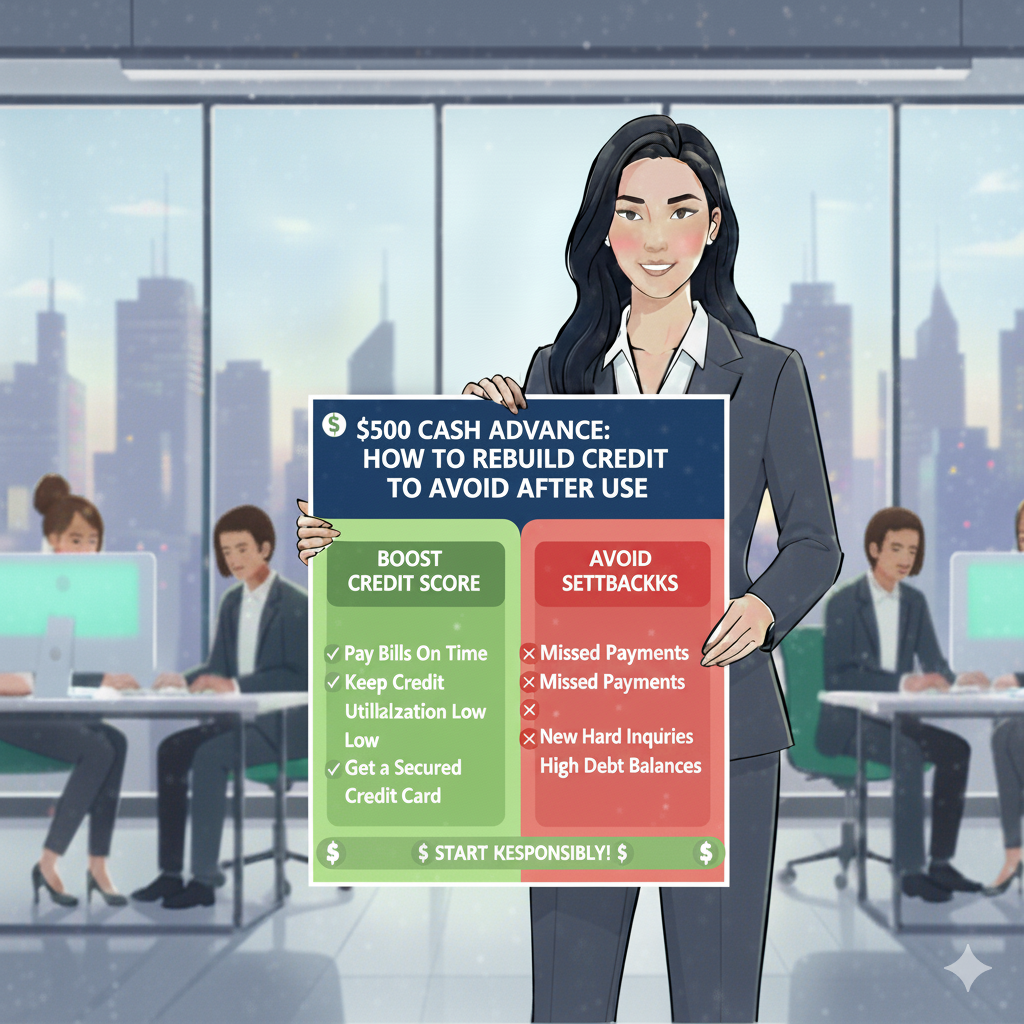
Step 1: Pay Off the Cash Advance as Agreed
The most important first step is to close the current loan without extra fees if possible. If your loan is still active, focus on the due date, payment amount, repayment method, and total payoff amount.
Before the payment date, confirm:
- the exact payment amount;
- the payment due date;
- whether repayment is automatic;
- which bank account will be debited;
- whether early payoff is available;
- whether paying early reduces cost;
- what happens if payment fails.
If repayment looks difficult, contact the lender before the due date. Ask whether a hardship option, payment plan, or installment arrangement is available. Avoid rolling over the loan automatically without understanding the added cost.
Step 2: Avoid Rollovers When Possible
Rolling over a cash advance means extending the due date, often by paying another fee. The risk is that the fee may not reduce the principal balance. You may pay more money while still owing the original loan amount.
| Repayment Choice | Possible Result | What to Ask |
|---|---|---|
| Pay on time | The loan closes according to the original agreement. | Can I get written confirmation that the loan is paid? |
| Pay early | May reduce cost if the lender allows interest or fee savings. | What is the exact payoff amount today? |
| Roll over | May add a new fee and extend the loan. | Does the fee reduce principal or only move the due date? |
| Installment arrangement | May spread repayment over time if available. | What is the new total repayment amount? |
If you are comparing a future $500 payday loan direct lender option, review rollover and renewal terms before signing.
Step 3: Check Your Credit Reports
After repayment, check your credit reports to see whether the loan, collection activity, or related account appears. You can also review reports for errors unrelated to the cash advance.
Look for:
- incorrect late-payment marks;
- accounts you do not recognize;
- incorrect balances;
- duplicate collection accounts;
- wrong personal information;
- accounts marked open when they should be closed;
- payments that were not updated correctly.
If you find an error, dispute it with the credit bureau and keep copies of payment confirmations, lender messages, and account statements.
Step 4: Build a Simple On-Time Payment System
Credit rebuilding depends heavily on consistency. A practical system can help you avoid late payments across loans, credit cards, utilities, rent-related obligations, subscriptions, and other bills.
- List every due date. Include loans, credit cards, utilities, insurance, rent, and phone bills.
- Set calendar reminders. Use reminders several days before each due date.
- Use autopay carefully. Autopay can help, but only if your account balance is reliable.
- Keep a small buffer. Leave extra money in the account before automatic withdrawals.
- Pay minimums first. Avoid missed payments before making extra payments elsewhere.
- Save payment confirmations. Keep records in case a payment is not credited correctly.
Step 5: Consider Credit-Builder Products Carefully
After repaying a cash advance, some borrowers use credit-builder tools to create positive payment history. These products may help, but only if the payment is affordable and reported to credit bureaus.
| Credit-Building Option | How It May Help | What to Watch |
|---|---|---|
| Secured credit card | May help build revolving credit history if payments are reported. | Requires a deposit; high balances can hurt utilization. |
| Credit-builder loan | May help build installment payment history. | Fees, interest, and reporting policies vary. |
| Small installment loan | May add payment history if reported. | Should not be used unless repayment is affordable. |
| Authorized-user account | May help if the primary account is managed well and reported. | Can hurt if the account has high balances or late payments. |
Before opening any new account, confirm fees, APR, reporting policies, due dates, and whether you can afford the payment without borrowing again.
Step 6: Keep Credit Card Balances Low
If you open or already have a credit card, try to keep the balance low compared with the credit limit. High balances can make credit rebuilding harder, even when payments are made on time.
A practical rule is to use only a small portion of available credit when possible and pay the balance down before the statement closes. If that is not possible, focus first on avoiding late payments and reducing balances over time.
Step 7: Be Careful With New Hard Inquiries
Applying for several new credit products in a short period can create hard inquiries and may signal risk to lenders. Some lenders may use soft inquiries for prequalification, while others may use hard inquiries during the formal application process.
Before applying, check:
- whether the review uses a soft or hard inquiry;
- whether a hard inquiry may happen later;
- whether the lender reports payment activity;
- APR, fees, and total repayment;
- whether the payment fits your budget.
Borrowers searching for no credit check loans or online loan no credit check should remember that “no credit check” does not mean no verification, no cost, or guaranteed approval.
Step 8: Use Bank Account Data Carefully
Some lenders may review bank-account data, income deposits, and cash-flow patterns instead of relying only on credit score. This can help some borrowers receive a broader review, especially if they have limited or damaged credit.
Bank-data review does not guarantee approval, lower APRs, better terms, or credit improvement. Before connecting a bank account, review:
- who receives access to your data;
- what information may be reviewed;
- how long access may last;
- how to revoke access where available;
- whether bank verification is separate from ACH repayment authorization;
- privacy and data-sharing terms.
Step 9: Replace High-Cost Borrowing With Lower-Cost Alternatives
If you have relied on high-cost short-term loans more than once, the next credit-building step is to reduce the need for repeat borrowing. That may mean building a small emergency fund, negotiating payment plans, using lower-cost credit, or reducing recurring expenses.
Alternatives to compare before another cash advance include:
- Payment plans: utility companies, medical offices, landlords, repair shops, or insurers may allow direct arrangements.
- Credit-union small-dollar loans: some credit unions offer lower-cost emergency loans, though review may take longer.
- Payday Alternative Loans: some federal credit unions offer PALs to eligible members.
- Employer paycheck advances: some employers or payroll providers offer early wage access.
- Side income or selling unused items: this may reduce how much you need to borrow.
- Borrowing from family or friends: this may reduce cost if repayment expectations are clear.
- Smaller loan request: borrowing less may make repayment easier and reduce total cost.
State Rules Can Affect Borrowing While Rebuilding
State rules can affect loan availability, fees, APRs, repayment terms, rollovers, credit disclosures, and whether certain short-term products are allowed. Your state can also affect which lenders or loan structures are available.
- Texas: Borrowers searching for loans for bad credit Texas should compare lender identity, fees, repayment terms, state availability, and credit-check disclosures carefully.
- Florida: Borrowers looking for Florida bad credit loans should review whether the product is a payday loan, installment loan, or another type of credit, and whether any credit reporting or inquiry may apply.
- Alabama: Borrowers comparing bad credit personal loans Alabama should check licensing, APR, fees, payment dates, state availability, and credit-check terms before accepting.
No matter where you live, avoid any offer that does not clearly explain lender identity, APR, fees, payment dates, total repayment, credit-check terms, reporting policies, and repayment method.
How EasyFinance.com Helps Borrowers Compare Options
EasyFinance.com helps borrowers compare online emergency loan options from participating lenders. This may help borrowers review possible offers and compare repayment terms before accepting a loan.
- Submit an online request. Provide basic personal, income, contact, and banking information.
- Participating lenders review your information. Each lender uses its own approval and credit-review criteria.
- Review possible offers. Compare loan amount, APR, fees, payment schedule, credit-check terms, funding conditions, credit-reporting policies where disclosed, and total repayment.
- Read the lender agreement. Check all disclosures before signing.
- Receive funds if approved and accepted. Timing depends on the lender, verification, signed documents, funding method, weekends, holidays, and bank processing.
EasyFinance.com is not the final lender and does not guarantee approval, same-day funding, lower fees, lender licensing, credit reporting, credit-score improvement, or a specific loan amount. The final lender decides whether to approve your request, how much to offer, what the loan costs, whether any credit review is used, whether payments are reported, when payments are due, and when funds may be sent.
How to Borrow More Safely While Rebuilding Credit
- Borrow only when necessary. Do not use short-term loans for non-essential spending.
- Compare total repayment, not just payment size. A smaller payment can cost more if the term is long.
- Check the legal lender name. Know who funds, services, and collects the loan.
- Review credit-check disclosures. Know whether a soft or hard inquiry may happen.
- Ask about credit reporting. Confirm whether on-time or late payments may be reported.
- Review ACH authorization. Automatic withdrawals can create overdraft risk if your balance is low.
- Avoid upfront fees. Be cautious if anyone asks you to pay money before funding.
- Ask about early payoff. Paying early may reduce cost if the lender allows it.
- Save the agreement. Keep loan terms, payment schedule, credit-check disclosures, lender contact details, ACH authorization, and payment confirmations.
Warning Signs to Avoid
| Warning Sign | Why It Matters |
|---|---|
| Guaranteed credit improvement | No lender or marketplace can guarantee that a loan will improve your credit score. |
| Guaranteed approval | Real lenders generally review identity, income, bank activity, state availability, and repayment ability. |
| Guaranteed same-day funding | Funding depends on approval, verification, cutoff times, weekends, holidays, funding method, and bank processing. |
| No clear lender name | You should know who funds, services, and collects the loan. |
| No clear credit-reporting policy | You should know whether payments may be reported before assuming credit-building benefits. |
| Missing APR or total repayment | You cannot judge affordability without the full cost. |
| Upfront fee before funding | Advance-fee scams may ask for money before sending approved funds. |
| Pressure to borrow again quickly | Repeat borrowing can make credit rebuilding harder. |
Key Insights
- A $500 cash advance may or may not affect your credit directly, depending on the lender’s credit-reporting policy.
- Repaying on time can help you avoid extra fees, collections, and further financial stress.
- Unpaid loans may damage credit if sent to collections or reported negatively.
- Credit rebuilding usually requires consistent on-time payments, low balances, careful use of new credit, and regular report monitoring.
- Credit-builder products may help only when they are affordable and reported to credit bureaus.
- EasyFinance.com is a BBB-accredited marketplace, not a direct lender.
- No marketplace or lender can guarantee credit-score improvement, approval, lower costs, or same-day funding.
FAQ: How to Rebuild Credit After Using a $500 Cash Advance
Does a $500 cash advance hurt my credit?
It depends on the lender and whether payment activity is reported to credit bureaus. On-time repayment may help only if reported. Late payments, collections, or unpaid balances may hurt your credit if reported.
Can a no-credit-check loan help rebuild credit?
Possibly, but only if the lender reports on-time payments to credit bureaus. Some no-credit-check lenders do not report positive payments, so borrowers should ask about credit reporting before assuming credit-building benefits.
What should I do first after using a cash advance?
Focus on repaying the loan as agreed. Confirm the due date, payment amount, repayment method, total payoff amount, and whether automatic withdrawals are scheduled.
What if I cannot repay on time?
Contact the lender before the due date. Ask about hardship options, payment plans, installment arrangements, or other repayment options. Avoid repeated rollovers when possible because added fees can increase the total cost.
Should I get a secured credit card after a cash advance?
A secured card may help rebuild credit if the issuer reports to credit bureaus and you keep payments on time. Review deposit requirements, fees, APR, credit limit, and reporting policies before applying.
Will applying for another loan lower my score?
It depends on whether the lender uses a soft or hard credit inquiry. Some lenders may start with a soft inquiry, while others may use a hard inquiry later. Review credit-check disclosures before applying.
Is it safe to link my bank account to lenders?
It depends on the lender, marketplace, verification provider, and consent terms. Review who receives access, what data may be reviewed, how long access lasts, how to revoke access, and whether bank verification is separate from ACH repayment authorization.
Why use EasyFinance.com while rebuilding credit?
EasyFinance.com is a BBB-accredited loan marketplace that helps borrowers compare online emergency loan options from participating lenders in one place. Borrowers should still review the final lender agreement, repayment terms, credit-check disclosures, and credit-reporting policies carefully before accepting any loan.
Related Resources
- How Direct Lender $500 Cash Advances Work vs. Loan Marketplaces
- Best States for $500 Cash Advance No Credit Check Loans in 2025
- $500 Cash Advance Approval Odds with Bad or Fair Credit
- Using Bank Account Data to Qualify for a $500 Cash Advance Fast
- Online $500 Cash Advance vs. Payday Loans — Which Costs Less?
- How to Avoid Predatory $500 Cash Advance Lenders Online
- Same-Day $500 Cash Advance Options When Banks Are Closed
- $500 Cash Advance With No Credit Check — Safe Borrowing Tips
- Alternatives to a $500 Cash Advance if You’re Short on Cash
- How to Spot Legitimate Direct Lenders for $500 Cash Advances
- $500 Cash Advance No Credit Check — Pros and Cons Explained
- The Real Cost of Rolling Over a $500 Cash Advance Loan
- How to Boost Approval for $500 Cash Advances Without Hard Pull
- Why Direct Lender $500 Cash Advances Are Faster Than Brokers
- Emergency $500 Cash Advance for Medical or Car Repairs
- $500 Cash Advance vs. Installment Loans — What to Choose?
- No Credit Check $500 Cash Advance for Gig and Freelance Workers
- $500 Cash Advance Repayment Strategies to Avoid Extra Fees
- How to Rebuild Credit After Using a $500 Cash Advance
- Comparing $255 Payday Loans vs. $500 Cash Advances — Key Differences


 EasyFinance Blog
 Twitter
 Facebook
 Google+
 LinkedIn
 Email Subscriptions