



Comparing $255 Payday Loans vs. $500 Cash Advances — Key Differences in 2026
When money runs short before payday, two common small-dollar options borrowers compare are $255 payday loans and $500 cash advances. They may look similar because both are often used for urgent expenses, but the loan amount, repayment structure, cost, and risk can be very different.
A smaller payday loan may help with a limited cash gap, while a $500 cash advance may help with a larger emergency such as a car repair, medical bill, utility payment, rent gap, prescription, or transportation cost. Neither option is automatically cheaper, safer, faster, or easier to qualify for.
Updated May 2026: EasyFinance.com is a BBB-accredited loan marketplace that helps borrowers compare online emergency loan options from participating lenders.
EasyFinance.com is not a direct lender. It does not make final approval decisions, set final loan terms, decide credit-reporting policies, or guarantee same-day funding. Approval, loan amount, APR, fees, repayment schedule, credit review, funding speed, credit reporting, and state availability depend on the final lender, your information, state rules, verification, and bank processing.
This guide explains how $255 payday loans and $500 cash advances compare, when each option may make sense, what costs to review, and what to check before accepting any short-term loan.
$255 Payday Loan vs. $500 Cash Advance: Quick Answer
- A $255 payday loan is usually a small short-term loan designed to be repaid around the borrower’s next payday.
- A $500 cash advance is usually a larger small-dollar loan or advance that may be used for bigger emergency expenses.
- The smaller loan is not automatically cheaper. Fees, APR, repayment timing, rollovers, and late-payment rules determine the real cost.
- The larger loan is not automatically better. Borrowing more can increase repayment pressure if the payment does not fit your budget.
- No-credit-check language does not mean guaranteed approval. Lenders may still verify income, identity, bank-account activity, state availability, and ability to repay.
- Funding speed is not guaranteed. Some approved borrowers may receive funds quickly, but timing depends on lender review, verification, cutoff times, signed documents, weekends, holidays, funding method, and bank processing.
- The most important number is total repayment. Compare the full amount you will repay, not just the loan amount or one payment size.
What Is a $255 Payday Loan?
A $255 payday loan is a small short-term loan often used to cover a temporary cash gap until the borrower’s next paycheck or income deposit. Some borrowers compare this type of loan when they need a smaller amount for gas, groceries, a phone bill, a minor utility payment, or another urgent expense.
Depending on the state and lender, payday loans may have strict rules around maximum loan amount, fees, repayment timing, renewals, and borrower eligibility. Some states restrict payday-style loans heavily, while others allow different small-dollar loan structures.
A smaller loan amount can reduce how much you need to repay, but the repayment window may still be short. If the full amount plus fees is due on your next payday, the payment may compete with rent, food, transportation, utilities, insurance, or other essential bills.
What Is a $500 Cash Advance?
A $500 cash advance is usually a small-dollar online loan or short-term advance used to cover a larger emergency. Depending on the lender and state, it may be structured as a payday-style loan, cash advance, installment-style product, or another form of credit.
Borrowers often compare a $500 cash advance no credit check when they need more than a very small payday loan can provide. Examples may include car repairs, medical bills, prescription costs, rent gaps, dental expenses, or urgent travel.
A $500 loan may provide more breathing room for a larger expense, but it also creates a larger repayment obligation. Borrow only what you need and review the full repayment amount before signing.
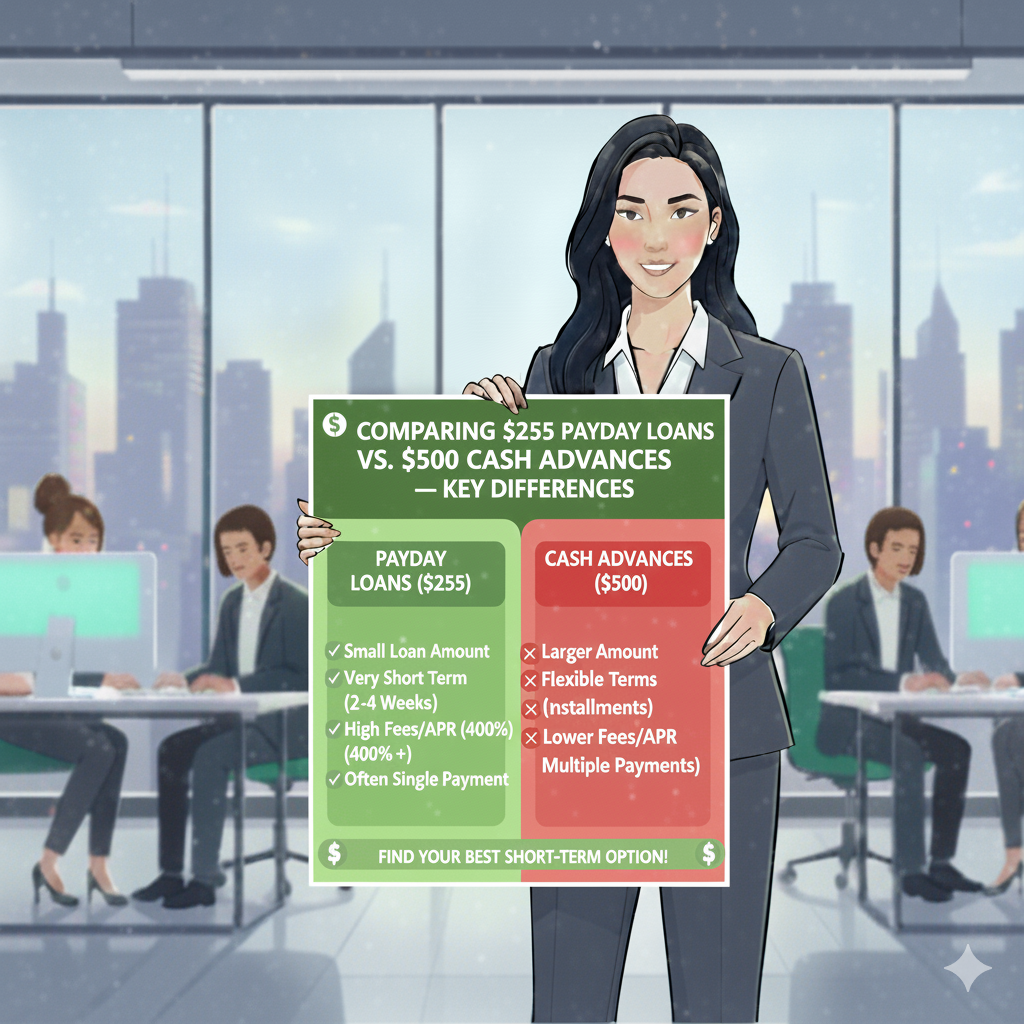
Key Differences Between $255 Payday Loans and $500 Cash Advances
| Feature | $255 Payday Loan | $500 Cash Advance |
|---|---|---|
| Loan amount | Smaller amount, often used for minor urgent expenses. | Larger amount, often used for bigger emergency costs. |
| Common use | Gas, groceries, phone bill, smaller utility bill, or short cash gap. | Car repair, medical bill, rent gap, prescription, dental bill, or larger emergency. |
| Repayment structure | Often due near the next payday, depending on the lender and state. | May be one payment or scheduled payments, depending on the lender and state. |
| Total repayment | May be lower in dollars because the loan amount is smaller, but fees can still be high relative to the amount borrowed. | May be higher in dollars because the loan amount is larger and repayment may last longer. |
| Main risk | Short repayment timing, rollover fees, and repeat borrowing. | Larger repayment amount, longer obligation, and automatic withdrawal risk. |
| Best question | How much will I repay in total, and can I make the payment without borrowing again? | |
Loan Amount: Smaller vs. Larger Emergency Needs
The clearest difference is the loan amount. A $255 payday loan may be enough for a small emergency, while a $500 cash advance may be more appropriate when the expense is larger.
A smaller loan may reduce repayment pressure if it fully solves the problem. But if you borrow too little and still cannot cover the emergency, you may end up needing another loan. A larger loan may cover the full expense, but it can also make repayment harder.
Before deciding, ask:
- What exact amount do I need?
- Can I reduce the bill with a payment plan or discount?
- Would borrowing less solve the emergency?
- Can I repay the full amount on time?
- Will repayment leave enough for essentials?
Repayment Terms: Lump Sum vs. Scheduled Payments
Many payday loans are designed for short repayment, often around the borrower’s next payday. That can be difficult if the full loan amount and fees are due at once.
A $500 cash advance may also have short repayment, but some lenders may offer installment-style repayment depending on the product and state. Installments can make payments easier to plan, but a longer repayment schedule can increase the total cost.
The better choice depends on cash flow. A smaller one-payment loan may work if you can repay in full without missing essentials. A scheduled-payment option may be easier to budget, but only if the total repayment is reasonable.
Fees, APR, and Total Repayment
Both $255 payday loans and $500 cash advances can be expensive compared with lower-cost credit options. The cost depends on the lender, state rules, APR, finance charges, repayment term, payment frequency, and whether you repay on time.
Before accepting any offer, compare:
- APR: the annualized cost of borrowing;
- finance charge: the dollar cost of the loan;
- total repayment: the full amount you will repay;
- payment amount: how much is due each time;
- payment frequency: weekly, biweekly, semi-monthly, monthly, or one-time repayment;
- loan term: how long repayment lasts;
- late fees: what happens if you miss a payment;
- returned-payment fees: what happens if an automatic debit fails;
- rollover or renewal rules: whether extensions are allowed and what they cost;
- early payoff rules: whether paying early reduces cost.
Cost Example: Why Total Repayment Matters
| Loan Detail | Smaller Loan | Larger Loan |
|---|---|---|
| Amount borrowed | $255 | $500 |
| Payment structure | May be one short-term payment. | May be one payment or scheduled payments. |
| Cost risk | Fees may be high compared with the amount borrowed. | Total repayment may be higher because the borrowed amount is larger. |
| Main affordability question | Can I repay in full on the due date? | Can I repay without missing essentials or borrowing again? |
The smaller loan is not automatically the better loan, and the larger loan is not automatically the worse loan. The right comparison is total repayment and budget fit.
Credit Impact: What Borrowers Should Know
Credit impact depends on the lender and product. Some lenders may report payment activity to credit bureaus, while others may not. Some may use a soft inquiry at the first stage, while others may use a hard inquiry later.
Before accepting either a $255 payday loan or a $500 cash advance, ask:
- Will a soft or hard credit inquiry be used?
- Does the lender report on-time payments?
- Does the lender report late payments?
- Could unpaid debt be sent to collections?
- Will collections be reported to credit bureaus?
Borrowers searching for no credit check loans or online loans no credit check should remember that no-credit-check language does not mean no verification, no cost, or guaranteed approval.
Approval Process and No-Credit-Check Review
Both payday loans and cash advances may use alternative review methods, but lender practices vary. A lender may review income, identity, bank-account activity, direct deposits, employment or benefits income, state availability, and ability to repay.
Borrowers with bad, fair, or limited credit may still be considered by some lenders, but approval is not guaranteed. Lower-credit borrowers may receive higher-cost offers or smaller loan amounts.
If you are searching for i need $500 dollars now no credit check, review the lender’s credit-check and repayment disclosures before accepting any offer.
When a $255 Payday Loan May Make Sense
A $255 payday loan may be worth comparing when the expense is small, urgent, and you are confident you can repay the full amount on time.
- The emergency is less than $255.
- You only need a small bridge until payday.
- You can repay the loan without missing rent, food, utilities, transportation, or insurance.
- You understand the APR, fees, due date, and total repayment.
- You have checked lower-cost options first.
A $255 payday loan may not be a good fit if the full repayment would leave you short again immediately after payday.
When a $500 Cash Advance May Make Sense
A $500 cash advance may be worth comparing when the emergency is larger and a smaller loan would not solve the problem.
- You need more than $255 for a necessary expense.
- The expense is urgent, such as a car repair, medical bill, prescription, or rent gap.
- You have steady income and a clear repayment plan.
- You can repay without borrowing again immediately.
- The lender clearly explains APR, fees, payment dates, credit-check terms, and total repayment.
Borrowers comparing a $500 payday loan direct lender should still compare alternatives, payment plans, and smaller loan amounts before accepting.
When Neither Option May Be the Right Choice
A $255 payday loan or $500 cash advance may not be a good fit if the loan would create another financial problem.
- You are borrowing to repay another loan.
- You already have several short-term loans open.
- You do not know when your next reliable income will arrive.
- The lender does not clearly show APR, fees, payment dates, and total repayment.
- Automatic withdrawals could overdraw your bank account.
- The payment would leave you short for essentials.
- You feel pressured to sign immediately.
In those cases, compare a payment plan, credit-union loan, employer advance, local assistance program, side-income option, or smaller borrowing amount before accepting a loan.
State-Specific Borrowing Considerations
Loan rules differ by state. State laws can affect maximum loan amounts, APRs, fees, repayment terms, rollovers, renewals, licensing, credit disclosures, and whether payday-style products are available.
- Texas: Borrowers searching for loans for bad credit Texas should compare lender identity, fees, repayment terms, state availability, and credit-check disclosures carefully.
- Florida: Borrowers looking for Florida bad credit loans should review whether the product is a payday loan, installment loan, or another type of credit, and whether any credit reporting or inquiry may apply.
- Alabama: Borrowers comparing bad credit personal loans Alabama should check licensing, APR, fees, payment dates, state availability, and credit-check terms before accepting.
No matter where you live, avoid any offer that does not clearly explain lender identity, APR, fees, payment dates, total repayment, credit-check terms, reporting policies, and repayment method.
How EasyFinance.com Helps Borrowers Compare Options
EasyFinance.com helps borrowers compare online emergency loan options from participating lenders. This may help borrowers review possible offers and compare repayment terms before accepting a loan.
- Submit an online request. Provide basic personal, income, contact, and banking information.
- Participating lenders review your information. Each lender uses its own approval and credit-review criteria.
- Review possible offers. Compare loan amount, APR, fees, payment schedule, credit-check terms, funding conditions, credit-reporting policies where disclosed, and total repayment.
- Read the lender agreement. Check all disclosures before signing.
- Receive funds if approved and accepted. Timing depends on the lender, verification, signed documents, funding method, weekends, holidays, and bank processing.
EasyFinance.com is not the final lender and does not guarantee approval, same-day funding, lower fees, lender licensing, credit reporting, credit-score improvement, or a specific loan amount. The final lender decides whether to approve your request, how much to offer, what the loan costs, whether any credit review is used, whether payments are reported, when payments are due, and when funds may be sent.
Alternatives to Compare Before Borrowing
Before accepting either a $255 payday loan or a $500 cash advance, compare alternatives that may cost less or provide more time to pay.
- Payment plans: Utility companies, medical offices, landlords, repair shops, or insurers may allow direct arrangements.
- Credit-union small-dollar loans: Some credit unions offer lower-cost emergency loans, though review may take longer.
- Payday Alternative Loans: Some federal credit unions offer PALs to eligible members.
- Employer paycheck advances: Some employers or payroll providers offer early wage access.
- Side income or selling unused items: This may reduce how much you need to borrow.
- Borrowing from family or friends: This may reduce cost if repayment expectations are clear.
- Smaller loan request: Borrowing less may make repayment easier and reduce total cost.
How to Borrow More Safely
- Borrow only what solves the emergency. Do not accept a larger loan just because it is available.
- Compare total repayment, not just loan amount. A smaller loan can still be expensive if fees are high.
- Check the legal lender name. Know who funds, services, and collects the loan.
- Review credit-check disclosures. Know whether a soft or hard inquiry may happen.
- Ask about credit reporting. Confirm whether on-time or late payments may be reported.
- Review ACH authorization. Automatic withdrawals can create overdraft risk if your balance is low.
- Avoid upfront fees. Be cautious if anyone asks you to pay money before funding.
- Ask about early payoff. Paying early may reduce cost if the lender allows it.
- Save the agreement. Keep loan terms, payment schedule, credit-check disclosures, lender contact details, ACH authorization, and payment confirmations.
Warning Signs to Avoid
| Warning Sign | Why It Matters |
|---|---|
| Guaranteed approval | Real lenders generally review identity, income, bank activity, state availability, and repayment ability. |
| Guaranteed same-day funding | Funding depends on approval, verification, cutoff times, weekends, holidays, funding method, and bank processing. |
| No clear lender name | You should know who funds, services, and collects the loan. |
| No clear credit-reporting policy | You should know whether payments may be reported before assuming credit-building benefits. |
| Missing APR or total repayment | You cannot judge affordability without the full cost. |
| Upfront fee before funding | Advance-fee scams may ask for money before sending approved funds. |
| Unclear ACH terms | Automatic withdrawals can cause overdraft problems if your account balance is low. |
| Pressure to borrow more than needed | A larger loan can increase repayment stress. |
Key Insights
- $255 payday loans and $500 cash advances are both small-dollar emergency options, but they differ in loan amount, repayment pressure, and total cost.
- A $255 payday loan may fit a smaller emergency, while a $500 cash advance may fit a larger urgent expense.
- Neither option is automatically cheaper, safer, faster, or easier to qualify for.
- Credit impact depends on the lender’s inquiry and reporting policies.
- No-credit-check language does not mean no verification or guaranteed approval.
- EasyFinance.com is a BBB-accredited marketplace, not a direct lender.
- The most important number is total repayment, not approval speed, funding speed, or the advertised loan amount.
FAQ: $255 Payday Loans vs. $500 Cash Advances
Is a $255 payday loan easier to get than a $500 cash advance?
Not necessarily. Approval depends on the lender, your income, bank-account activity, identity verification, state availability, and ability to repay. A smaller loan may be easier to repay, but approval is still not guaranteed.
Which option is cheaper overall?
It depends on APR, finance charges, fees, repayment timing, rollovers, and whether you repay on time. Compare total repayment before accepting either option.
Can I get either loan with bad credit?
Some lenders may consider borrowers with bad, fair, or limited credit by reviewing income, bank-account activity, identity, state availability, and ability to repay. Approval is not guaranteed.
Can I get same-day funding?
Some approved borrowers may receive funds the same day or next business day, but same-day funding is not guaranteed. Timing depends on lender approval, verification, cutoff times, weekends, holidays, funding method, and bank processing.
Do $500 cash advances report to credit bureaus?
Some lenders may report payment activity, while others may not. Ask the final lender whether on-time or late payments may be reported before assuming any credit-building benefit.
Are payday loans or cash advances safer?
Neither option is automatically safe or unsafe. A safer offer clearly shows lender identity, APR, fees, payment dates, total repayment, ACH terms, credit-check disclosures, and early payoff rules before you accept.
Does EasyFinance.com decide my loan terms?
No. EasyFinance.com is a marketplace, not the final lender. The final lender decides approval, APR, fees, repayment schedule, credit review, reporting policies, and funding timing.
Why use EasyFinance.com?
EasyFinance.com is a BBB-accredited loan marketplace that helps borrowers compare online emergency loan options from participating lenders in one place. Borrowers should still review the final lender agreement, repayment terms, credit-check disclosures, and credit-reporting policies carefully before accepting any loan.
Related Resources
- How Direct Lender $500 Cash Advances Work vs. Loan Marketplaces
- Best States for $500 Cash Advance No Credit Check Loans in 2025
- $500 Cash Advance Approval Odds with Bad or Fair Credit
- Using Bank Account Data to Qualify for a $500 Cash Advance Fast
- Online $500 Cash Advance vs. Payday Loans — Which Costs Less?
- How to Avoid Predatory $500 Cash Advance Lenders Online
- Same-Day $500 Cash Advance Options When Banks Are Closed
- $500 Cash Advance With No Credit Check — Safe Borrowing Tips
- Alternatives to a $500 Cash Advance if You’re Short on Cash
- How to Spot Legitimate Direct Lenders for $500 Cash Advances
- $500 Cash Advance No Credit Check — Pros and Cons Explained
- The Real Cost of Rolling Over a $500 Cash Advance Loan
- How to Boost Approval for $500 Cash Advances Without Hard Pull
- Why Direct Lender $500 Cash Advances Are Faster Than Brokers
- Emergency $500 Cash Advance for Medical or Car Repairs
- $500 Cash Advance vs. Installment Loans — What to Choose?
- No Credit Check $500 Cash Advance for Gig and Freelance Workers
- $500 Cash Advance Repayment Strategies to Avoid Extra Fees
- How to Rebuild Credit After Using a $500 Cash Advance
- Comparing $255 Payday Loans vs. $500 Cash Advances — Key Differences


 EasyFinance Blog
 Twitter
 Facebook
 Google+
 LinkedIn
 Email Subscriptions